
The Digital Engine Acquisition Channels
When it comes to acquisition channel selection, you have options to choose from based on social media channels’ demographic targets presented in the last section. For this course, at a minimum, you need to select three social media channels that you will use to distribute your content. Obviously, there are many options to choose, including Facebook, Instagram, LinkedIn, Twitter, Pinterest, Etsy, Reddit, Snapchat, Tik Tok, the list can go on seemingly forever, updating each new day. The only requirement here is that one of your channels MUST be Facebook. As of September 2021, Facebook has over 2.89B users, that is 37.4% of the world’s population (7.73B people). Therefore, it is critical that you understand how to use Facebook from an inbound marketing perspective. This is what we call the business side of Facebook (not just the consumer side). It’s inevitable that in business someday, you more than likely will be using Facebook in some marketing capacity, so we require it as part of this practicum. However, the other two or more channels is completely up to your discretion. You can choose anything you want, but again, as we have already discussed, these channels need to be heavy favorites of your primary targeted audiences. The “who” is an important consideration when choosing the “where!”
Additionally, in your consideration of which acquisition channels to choose, we also need to consider our content matrix parts from the last two chapters. With the target market segments and serialized content having already been identified, it is now time to determine which social media channels will be utilized to distribute each serialized marketing message. As you can see from Cul2vate’s content matrix from the last chapter, Cul2vate has formulated twenty serialized marketing messages that they can be repeated on some desired basis. That is, four target markets multiplied times the five serialized content areas equals twenty message options. In other words, where one of the target market columns intersects with one content area row within the matrix, then one serialized marketing message has been identified. Let’s examine just one of these interactions (“Growing Techniques”) for a deeper look.
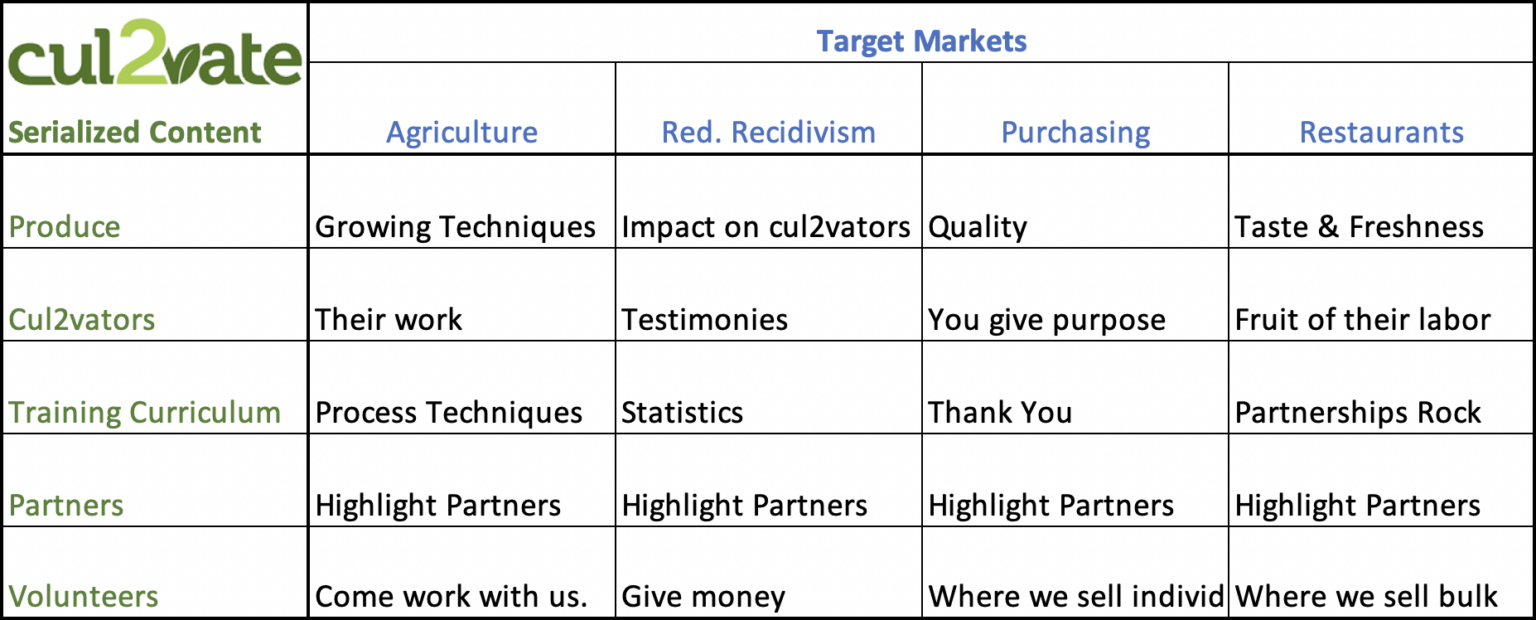
“Growing Techniques” is one marketing message that can be serialized over a period of time with people who are interested in agriculture. For the target market of people interested in agriculture, Cul2vate will provide them content about all the processes and results of how they grow produce. The written content will include blogs and social media posts about Cul2vate’s growing techniques and provide visual demonstrations of what techniques they use to grow produce on their farm. These visual demonstrations could come in the form of pictures of the produce at various stages of growth, or include video updates as they demonstrate actual techniques. There is so much potential here in various forms or styles of content that Cul2vate can use to draw interest from that target audience.

Cul2vate could include a how-to manual for soil preparation and watering needs. It could include a video demonstration of how to pack and ship. But most importantly, relative to this discussion on content distribution, each of these different methods for discussing and demonstrating these growing techniques can be and should be unique to distinctive social media channels. Some social media channels, like Facebook and Instagram use pictures to convey meaning, while YouTube uses videos, and Twitter uses up to 280 characters to emphasize the immediacy of the moment. Therefore, in addition to the previous version of the content matrix, you must now expand the matrix by including the social media channel strategies. A potential example of Cul2vate’s expanded content matrix is demonstrated below.
As seen in the expanded example below, Cul2vate has designed a channel strategy that communicates marketing messages within the same serialized area of content, but it is targeted specifically for a group of consumers who care deeply about agriculture. The different channel strategies allow Cul2vate to target the various demographics across each channel but using the specific format that each social media channel promulgates. This creates an avenue to reach these target audiences across different social media platforms, across different demographics, and across preferred presentations styles, either written, verbal, or pictorial. Remember, all of this happens within just one of the target market x serialized content area interactions. As you recall from the first content matrix example above, there are still nineteen more interactions for which to strategize.

While this methodology seems simple, experience in this methodology has demonstrated that many individuals and companies fail to strategically plan for all of these content marketing processes. Many just create a blog and start to share content that is top of mind. This lack of strategic planning has multiple downfalls. First, without the planning process and identification of the various opportunities for content that exist across the content matrix’s interactions, the individual blogger or company soon runs out of top-of-mind ideas. Content creation becomes a tedious chore of trying to “think up” new relevant content. The stream of creative thought slows to a trickle and the number of posts required to maintain certain social media channels becomes atrophied. In fact, many social media channels remain open but become stagnant, rotting the foundation of your branding elements.
Most importantly, starting with content without strategic planning it first causes a company to back into a story line that is often incongruent with their brand narrative. If they have a branding strategy, the company is trying to disseminate this strategy to consumers from the top down, while social media messages are coming from the bottom-up. Many times, these messages are inconsistent and convey completely different meanings to the same group of targeted consumers. This is especially true for companies that have separate social media departments acting as silos separate from corporate branding departments. As we have stated previously, if your content matrix is NOT derived from your branding elements, then your marketing message will cause The Digital Engine to misfire, lowering your digital communication effectiveness. Once this occurs, internal corporate decisions can quickly negate the entire strategic inbound marketing plan, causing an immense amount of monetary and non-monetary damage.