
Consumer Retention through Email
Did you know that email was being used before society’s adoption of the Internet? It’s true. In 1965, users of a single computer at MIT used a program called “Mailbox.” Users of this computer could leave messages to other university users, who would see the messages the next time the person logged into the computers. The system was very effective, but the only limitation was that everyone had to use the same computer to receive the message.
Then in 1969, the US Department of Defense implemented project ARPANET (Advanced Research Projects Agency Network). This project networked numerous computers across the department for the purpose of communication within the organization. It was like the first version of our modern-day Slack. The first computer-to-computer message was sent on October 29th, 1969[1].
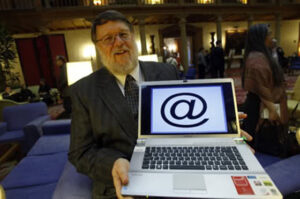 In 1971, a gentleman named Ray Tomlinson invented and developed electronic mail. This internal communication process within organizations proved to be so beneficial and practical that it soon began to spread and use became more popular, but it also became more complex. When considering how to send messages between organizations, rather than just within, a question developed of how to ensure that a message would go where it was intended to go. It was Ray Tomlinson (pictured to the right) that came up with the answer by propagating the use of the “@” symbol. To address a specific destination, Ray established the use of the email formula: “username@name_of_computer.” To this day, we still essentially use the same formula.
It wasn’t until the 1980’s, during the infancy of the Internet, that Internet Service Providers (ISPs) started connecting people across the world. This is when the first email hosting sites became established, all scrambling for just a small piece of this potentially very large pie. It wasn’t until 1993 that the words “electronic mail” were replaced by “email” as a public lexicon when Internet use had become more widespread. Over the next decade, email providers like America Online (AOL), Hotmail, and Yahoo invested millions of marketing dollars to increase awareness and accessibility to the masses. In the late 1990’s, everyone was using the Internet. Between 1997 and 1999, growth exploded from 55 million users to over 400 million. With the dawn of a new millenium, email was no longer a luxury, it was a societal necessity, akin to having a phone number; however, with the growth of email grew the use of spam, requiring email sorting software, like Microsoft Outlook, to help consumers keep track of important and non-important communication[1].
Subsequently, regulation was going to be needed unfortunately, especially as non-solicited pornography was being sent in heavy volumes from network-to-network. Therefore, in 2003, President George W. Bush signed into law the CAN-SPAM Act, 32 years after Ray Tomlinson’s invention in 1971. However, the regulation, called the “Controlling the Assault of Non-Solicited Pornography and Marketing” Act, did not seem to have enough teeth as it only made the act of spoofing a “From” field as a misdemeanor. It also did NOT make it illegal to send unsolicited email marketing messages from a legitimate email address if you provide people a way to opt out of the subscription list. Today, we know this as white list compliance, but because the CAN-SPAM Act did not make this spam process illegal, it became alternatively known to many as the “You Can-Spam” Act[2].
Then in 2004, Google changed the game with the launch of Gmail. One whole gigabyte of storage space, improved search functionality, threaded conversations, tabbed inboxing, and overcoming new obstacles for email deliverability set Google on the trajectory to the company it is today. Between 2004 and 2012, the strategic use of email was studied and enhanced by marketing strategists. In fact, political strategists have been praised for their work on President Barak Obama’s 2012 election campaign as one of the primary reasons for his campaign success. The most opened subject line from the Obama campaign merely just said “Hey.” And what the public came to learn about the CAN-SPAM Act around this time was that political campaigns are not subject to it. There is no way to opt out of unsolicited political emails from spoofed “from” fields. Since the CAN-SPAM Act was signed, several other, states, countries and even continents have increased legislation on spam. California’s Consumer Privacy Act (CCPA), Canada’s Anti-Spam Legislation (CASL) and Europe’s General Data Protection Regulation (GDPR) have all been instituted to discourage and curb unsolicited emails. Now, all email service providers, like MailChimp that we will use in this course, all must adhere to these regulations as they deploy their email services across the globe.
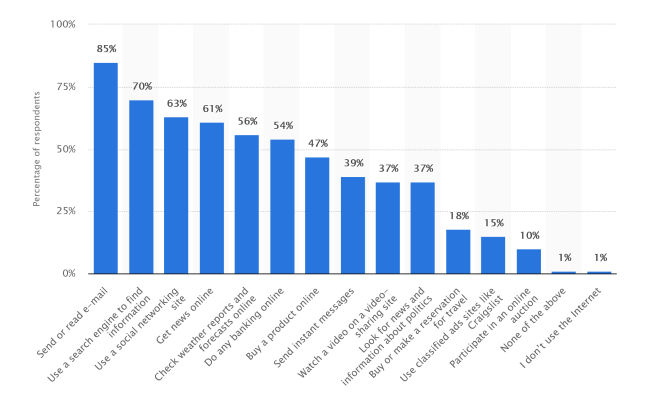
Today, through these email service providers, email marketing campaigns are used by businesses or individuals to communicate with current and potential customers. They are used to engage customers with the company, and often are used to persuade customers towards a call-to-action, and are a very important part of an inbound marketing campaign[3]. Additionally, it is a cost-efficient way to market your brand to a returning customer base. Most importantly, research shows that email marketing isn’t going anywhere, as billions of people still use email worldwide. In fact, recent research demonstrates that worldwide, there are 3.8 billion people who still use email. That is 50% of the world’s population, and this figure is expected to grow at 3% over the next four years[4]. In 2018, it was reported humans sent 281 billion emails per day, and in the United States alone, more than 85% of adults send or read email[5]. Not only do these billions of emails get sent, but according to DMA Insights, the average deliverability rate for email is 98.3%[6]. This means that emails reach almost all of the people for whom they are intended, which makes them a very powerful and cost-effective tool in the inbound marketing arsenal.
Worldwide Email Users (M), 2018-2022 (Radicati.com)
Unfortunately, today, consumers are also hit with more emails than they can process, and 17.3% of those are sent to the spam folder[4]. Additionally, ExactTarget reports that the majority of consumers (58%) check their email first thing in the morning before doing anything else online, which is more than Online Search (20%) or Facebook (11%)[7]. With this relevance, many companies find that it improves lead generation and sales. In fact, EmailMonday.com reported in 2015 that email marketing has a 38 to 1 return on investment; that is, for every one dollar you spend in email marketing, you receive $38 in return[8], and that was a several years ago. Therefore, getting consumers to pay attention to your email is of utmost concern, which is where many companies turn to flashy, graphic-based platforms.
 However, before you agree with these tactics, let us suggest a different perspective that we call “Email 1-2-3.” This approach suggests the following prescription:
- 1 Second to see who an email is from – Who in What Company
- 2 Seconds to see what it is about – The Subject Line
- 3 Seconds to check the body of the email to get the content, determine interest and click to continue to the site for more.
Our Email 1-2-3 strategy operates under the same guidelines as an email from one person to another (person-to-person) being that it has no logo attached or marketing header. Graphic image and traditional marketing emails require digital pictures to be downloaded. This produces a strong resistance to read through the email, and can also cause broken images, and in some cases, virtually unreadable email. Additionally, graphically formatted marketing emails are associated with solicitation or even “hard sell” ad emails. Finally, graphical header displays just push the content below the fold. Images and branding beyond email content need to be built into the on-page content and design of the website and may need to include a vertical landing page strategy.
Instead, our strategy is designed around a text based version, even though it is in HTML format with clickable links, to make it look readable and friendly. These types of emails with no context images eliminate the need of a required download making them immediately readable, mobile friendly, and “light.” The principal focus of the email is on content and the click-through to the website for conversion opportunities.
References:
[1] A Brief History of Email: Dedicated to Ray Tomlinson. https://phrasee.co/blog/a-brief-history-of-email/. Accessed 10/18/22.
[2] The History of Email: Major Milestones from 50 Years. https://www.digitaltrends.com/mobile/is-your-smartphone-listening-to-your-conversations/. Accessed 10/18/22.
[3] Hubspot.com: What is an email marketing campaign? https://blog.hubspot.com/blog/tabid/6307/bid/32854/10-simply-awesome-examples-of-email-marketing.aspx. Accessed 10/18/22.
[4] The Radicati Group, Inc. Email Statistics Report, 2018-2022. https://www.radicati.com/wp/wp-content/uploads/2017/12/Email-Statistics-Report-2018-2022-Executive-Summary.pdf. Accessed 10/18/22.
[5] Optinmonster.com: Is Email Marketing Dead? Here’s what the statistics show. https://optinmonster.com/is-email-marketing-dead-heres-what-the-statistics-show/. Accessed 10/18/22.
[6] DMA.org: Email benchmarking report 2017. https://dma.org.uk/research/email-benchmarking-report-2017. Accessed 10/18/22.
[7] Exact Target: Digital Morning. http://image.exct.net/lib/fe641570776d02757515/m/1/SFF1-TheDigitalMorning.pdf. Accessed 10/18/22.
[8] EmailMonday.com https://www.emailmonday.com/dma-national-client-email-report-2015/. Accessed 10/18/22.