
First, let’s look at the difference between brand positioning, product positioning, and product repositioning:
- Brand Positioning refers to the rank the company’s brand possesses in the customer’s mind relative to its competition.
- Product Positioning is the process used to determine how to communicate product attributes to the target customers based on customer needs relative to the offerings of competitive products.
- Product Repositioning is the task of implementing a major change to the target market’s perception of the product’s key benefits and features, relative to the offerings of competitive products.
Product positioning is the process used to determine how to best communicate product attributes to the target customers based on customer needs, competitor products and how the company wants its products to be perceived by the customers. Product positioning is very important for large scale companies who offer many products in the same category. This assists such companies to cater to different needs in their target market by providing a wide variety of choices and minimizing market cannibalization (products of the same company competing against each other to acquire customers)[1].
For example, The Coca Cola Company offers a number of products under the soft drinks category, and each product is different in terms of logo, taste and the target customers.
- Coca-Cola – this is the main corporate product of the company and uses mass marketing techniques (high volume of sales) and targets young customers
- Minute Maid – Minute maid is targeted for the health conscious customers who wish to consume a drink with natural energy
- Thumbs Up – Coca cola relates this soft drink with energetic and adventurous customers who love risk taking
Product positioning ensures that customers stay loyal to company’s products since the product portfolio fills all the need gaps in the market by offering a variety of products and leave little room for competitor products. To understand these gaps better, companies will research various product attributes to see where customers are being underserved. If there is a strategic alliance in that gap and the companies abilities to fill that gap with a product or service, then often companies will develop new products through this positioning analysis. Therefore, products can be positioned in any of the following ways[2]:
- Product attributes/benefits: Associating your product with certain characteristics or with certain beneficial value
- Product price: Associating your product with competitive pricing
- Product quality: Associating your product with high quality
- Product use and application: Associating your product with a specific use
- Competitive: Making consumers think that your product is better than that of your competitors
Once research has been collected in a number of these areas, companies will often use a perceptual map to compare products (or, in a larger sense, brands) against competing products/brands to see where the gaps in the marketplace may exist. Take the following perceptual map for example[3]. In this study, specific models of cars were evaluated to see if Nissan could identify a gap for a particular class of car. What they found was a gap in the family/economy sector:
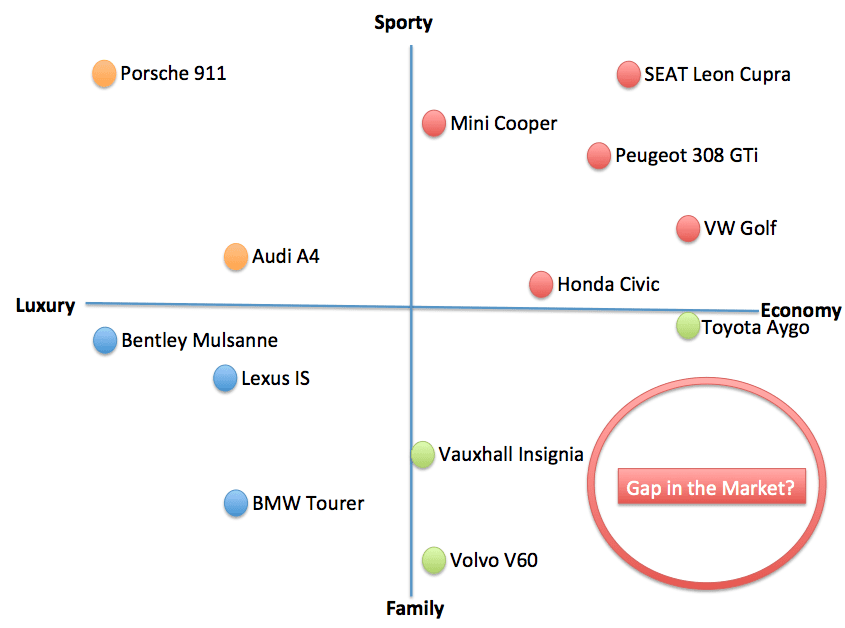
Perceptual maps can also be helpful when a company wants to reposition a particular product in the marketplace. Using the same example above, a company like Volvo may want to reconsider repositioning their Volvo V60. According to the research, the consumers in this model class are expressing that they view the V60 as a family car, which by safety ratings is not a surprise. However, Volvo would be surprised to learn it is viewed more as an economy car rather than a luxury car. With a repositioning of the V60, Volvo can add features and benefits more in line with the luxury offering of Lexus and BMW, for which they can raise the luxury perception and in the end, ask a higher selling price which could mean a higher profit margin, like Kia has recently done with their Telluride and Sorento models. These models are in such demand that Kia is asking $5-10K more for each automobile they sell as a “market adjustment” per unit. Kia’s repositioning has changed consumers’ perception of not just these models, but of the brand as well. In comparison to their former competitors, they have truly raised the bar on affordable SUV’s that feel like luxury automobiles, providing immense value for their customers. And the consumer reports are in, the new Kia models are a huge hit.
What are the reasons that a brand or product should be repositioned? They include[4], but are not limited to:
- Decline stage of the product life-cycle (PLC)
- Declining sales or profit margin due to being positioned too close to a major competitor
- The introduction of a superior product by the company itself
- To support an overall strategic change by the firm
- To assist in entering new marketplaces or pursue new segments (Applies to your practicum specifically!)
- The brand/product has been classified as a dog in the BCG matrix
References:
[1] The Difference Between. https://www.differencebetween.com/difference-between-product-positioning-and-vs-brand-positioning/. Accessed 10/18/22.
[2] Corporate Financial Institute. https://corporatefinanceinstitute.com/resources/knowledge/strategy/market-positioning/. Accessed 10/18/22.
[3] Smart Insights. https://www.smartinsights.com/digital-marketing-strategy/customer-segmentation-targeting/segmentation-targeting-and-positioning/. Accessed 10/18/22.
[4] Market Segmentation Study Guide. https://www.segmentationstudyguide.com/understanding-repositioning/repositioning/. Accessed 10/18/22.