
Scheduling Your Editorial Calendar
We have been working through the Content Matrix, pressing towards planning an editorial calendar, showing the metamorphosis of transferring strategic ideas related to market segmentation, targeting, and positioning into the tactical process of creating a rolling editorial calendar. It began with the identification of target market segments and serialized content areas of messages, and continued with identifying the correct social media channels for those target markets. Now, we need to put that into an editorial calendar that is easy to follow and provides a nice visualization of the planned content. Let’s look at a 90-day rolling calendar example for Cul2vate below. We will examine three different 30-day sections (first 30 days, second 30 days, and last 30 days) to identify what content they have planned and scheduled (highlighted in yellow) versus what content they have planned and still need to create/curate (highlighted in green) versus what content that have not planned yet (highlighted in white). Below we look at the first thirty days.
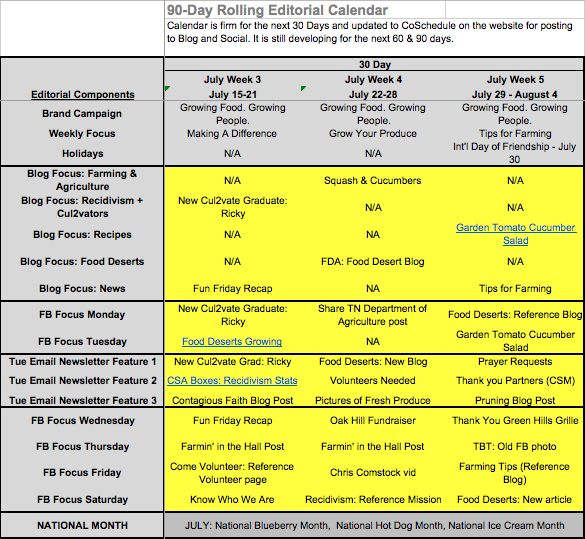
As we can see from the calendar above, Cul2vate has their first 30 days of content from this date rolling forward completely planned and scheduled on their social media management tool. Note: Cul2vate uses an application called Co-Schedule to assist them with the planning, scheduling, and most importantly, posting of their content. You will be introduced to the free version of CoSchedule in the next level of our courseware. There are other paid services services that may be familiar to you like Hootsuite, Buffer, or Later, but in this class, we will use CoSchedule.
Next, Cul2vate highlights in their blog a recent cult2vator graduate named Ricky, who has finished his year-long program with Cul2vate, staying out of jail and supporting himself while working on the farm. They also plan to blog some fun news regarding the week of work on the farm. They have their Facebook focus planned for every day (choosing not to post on Sunday due to their religious mission), and have three features they want to highlight on Tuesday, which is directed on continuing the process of creating relationship with their newsletter subscribers. Remember, the email has a retention focus, while the social media channels have an acquisition focus.
Currently, Cul2vate is primarily focused on just one social media channel, Facebook. If they were to expand into other social channels, then they could extend this calendar by adding more rows just above the National Month Reminder to include other social channels, like Instagram, Pinterest, Twitter, etc. Finally, notice that they don’t post a blog in every serialized topic category (blog focus rows) every week. They mix up these messages across weeks to give a good balance of new, fresh content every week. Let’s look at the next 30-days of the rolling calendar, which is the 60-day planning outlook.
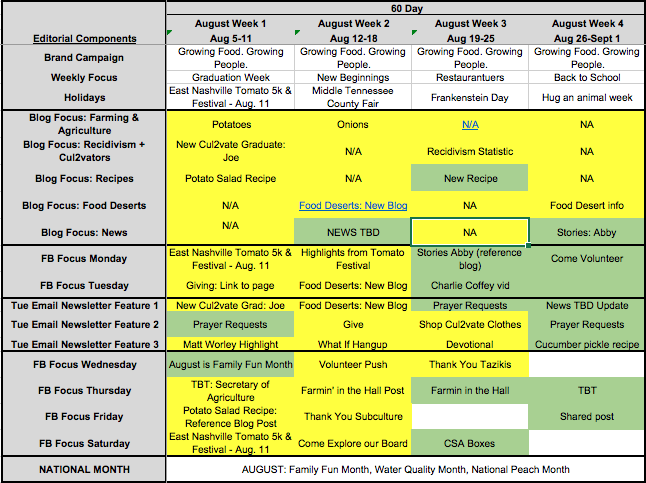
Above we see that Cul2vate does not have all of the content planned or scheduled. The first week of August is all planned, but they still have two pieces of content (highlighted in green) to write and schedule within CoSchedule. As you get later into this month of content, you see that there are more pieces that need to be both scheduled (in green) and even planned (blank spaces in white). In this instance, the social media coordinator needs to be speaking with people within the company to see if there are any ideas on what to plan and to ask if anyone would be willing to write a blog or post for these spaces that need to be filled. Also, notice the weekly focus at the top of the excel planner. Each week provides a general weekly theme to build consistency in message. Tying these weekly focuses back into the brand story is a great way to continue to strengthen the brand narrative and promises, which will in turn build brand belief and trust. Finally, let’s take a look at the 90-day planning outlook.
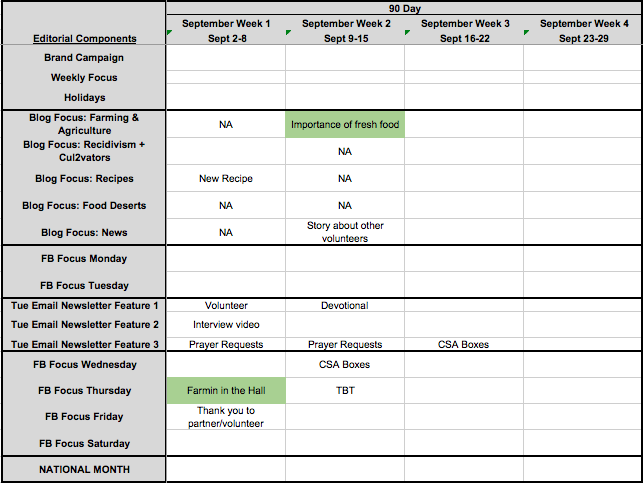
The 90-day outlook above is typical for the process. As you can see, effort is still going into finishing out the 60-day outlook, so planning for the 90-day is just beginning. Cul2vate needs to determine their weekly focus for each week and then start planning for each blog, Facebook post, and weekly email newsletter. It also needs to search for any special holidays or national month ideas in September for which they could creatively use in their planning, like Labor Day in Week 1.
The finalized editorial calendar for each company or individual will vary based on the number of target segments, buckets of serialized messages, and social media channels that are incorporated into the message matrix, and by how many resources are available to the company or firm. But most importantly, it is absolutely vital that you have a rolling editorial calendar. The entire inbound marketing campaign premise is built on having this calendar and it working for you to plan and schedule creative content with messages that are on-brand. Staying up-to-date with your editorial calendar should help minimize any brand misconceptions and keep you in a successful lane of targeted messages and digital growth.