
Target Market Selection
Recall from the previous section that a market is a group of individuals or organizations that have a need for a product or service and have the ability and willingness to purchase that product or service. Therefore, a target market is a group of individuals for which a firm has created a specific type of product for a specific group of consumers. For example, there is an entire sock market in the world. Consumers in this market can choose from many different types of socks, including dress socks, casual socks, running socks, hiking socks, etc. All of these different types make up the entire sock market, but consumers choosing a specific type of sock would be categorized into a market segment. Let’s take a look at four types of targeting strategies below.
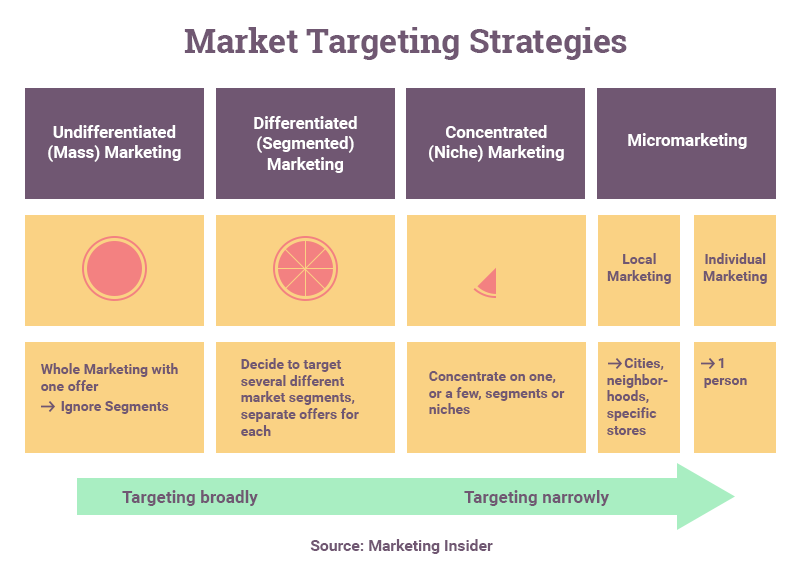 Within the entire sock market, there are many different sock manufacturers. One firm could choose an undifferentiated targeting strategy (also known as mass marketing) and attempt to sell socks to all these different groups, or market segments, with a single marketing mix (the 5P’s of marketing). These firms assume that all customers in this target market have similar needs, and thus the firm can satisfy most customers with little to no variation to the product. The advantage to this approach is the potential production and marketing costs savings associated with only one style or type of product, while the disadvantages range from unimaginative product offerings to substantial competitive threats. Most often this targeting strategy is successful with commodities and staple food items, or first movers to market. In a historically well-defined sock market, this approach would be very difficult.
However, the sock manufacturer could also choose to sell socks to one or more of these market segments using either a concentrated targeting strategy or a differentiated target strategy. A concentrated targeting strategy is when a firm uses a single marketing mix to target only one market segment. Also known as a “niche” approach, the primary advantage to this strategy is that it allows a firm to specialize on a distinct consumer group. It can concentrate its resources and specifically focus on meeting the needs of that individual market segment. The disadvantage is that the firm runs the risk of this specialized segment being (or becoming) too small to support profitability. Sometimes, this approach can lead to marketing myopia, which is a nearsightedness when the firms focuses more on its own needs rather than the needs of its customers. It prohibits firms from seeing rapid changes in the market, and the firm operating this strategy could become quickly susceptible to changing market conditions. In the sock example, this would include a manufacturer that decided to only target customers looking for running socks.
Often, over time, if firms begin with a successful concentrated targeting strategy, they will expand into additional market segments with a different marketing mix for each segment. This organization strategy is known as a differentiated targeting strategy (also known as multi-segment targeting). The advantages of this strategy most often include greater overall sales and greater financial success with economies of scale, which reduces the variable costs per unit that arise from increased total output of a product. However, because this strategy demands more production capacity, materials, and production labor, it most likely will result in higher overall production costs. In continuing our sock example, a manufacturer that chooses this multi-segment strategy will target customers looking for different types of socks, providing them an option within their brand portfolio that could include not only running socks, but also hiking socks and snow-skiing socks. With each of these target segments, the manufacturer would highlight specific product benefits to each different style of sock, along with price, available retailers, and seasonal promotions for each style.

But as we discussed in Chapter 1, with the advent of Web 2.0+, digital marketing now allows for another very concentrated approach; however, micromarketing goes one step further than concentrated marketing. In fact, micromarketing targets a specific group (localized micro-segments), or individuals, within a niche market. This strategy is highly targeted as all marketing efforts are focused on the distinct characteristics of these small groups or individuals. A great example of micromarketing is Groupon. Groupon is a digital marketplace where users are able to access coupons online, from holidays and retail products to sports massages and date nights. Groupon allows users to get location-based deals from almost any digital device. It was launched in 2008 and since then, Groupon has grown to be the most popular website for discounts and promotions in the United States, as it uses hyper-tailored targeting techniques to track user activity and the tailor content and deals accordingly as Groupon prioritizes the customer. As Hurree states, “whilst some disadvantages of micromarketing (like potential difficulty to expand or higher cost per acquisition) are apparent for many brands, the versatility of Groupon’s offerings and their highly personalized and customizable discounts lead them to be almost exempt from this digital sterilization”[1].
References:
[1] Hurree: https://blog.hurree.co/blog/market-targeting. Accessed 10/18/22.