
Market Segmentation
As you will see in this chapter, reaching customers with right message in the right market is essential to marketing success. If you reach too broadly, then your message most likely reach too many people who aren’t interested in your product and services. If you reach too narrowly, then you may leave a lot of potential sales on the table because more people didn’t hear your message. Therefore, a developed market segmentation approach will help you to target just the people most likely to become satisfied customers and advocates for your brand. To segment consumers of your product, service, or content, you must split them up into groups that have similar needs and characteristics. This is market segmentation.
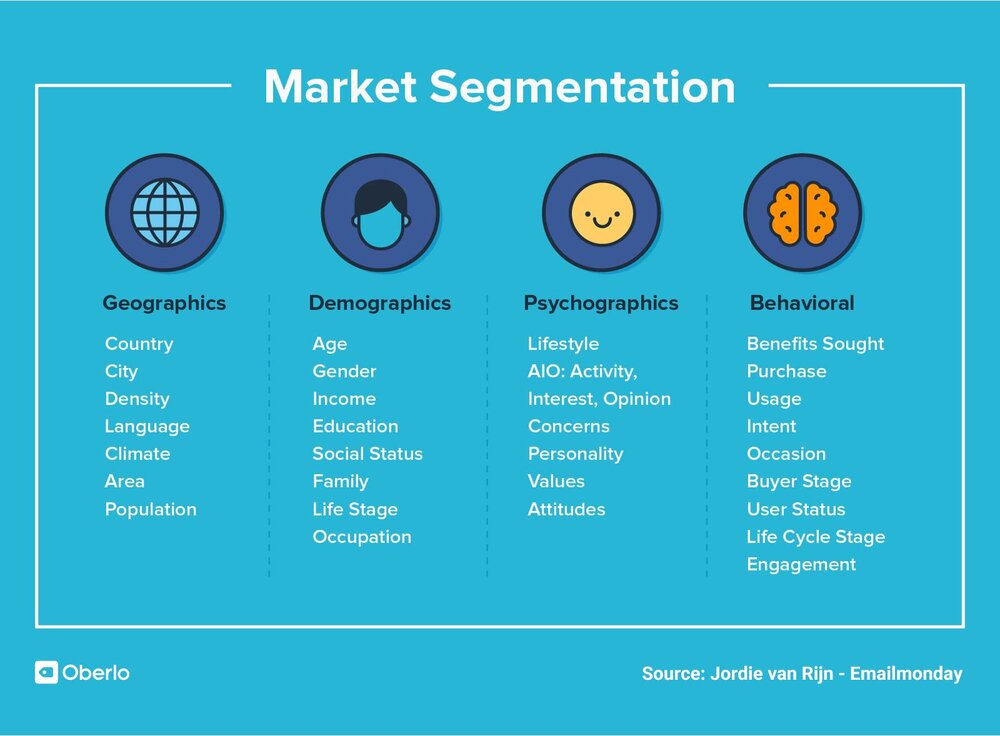 How do companies segment consumers? The most common segmentation methods include geography, demographics, psychographics, behavior, and benefits sought. Geographics is obviously about where in the city, state, nation, or world that a person lives. This approach segments based on location. Demographics is also one in which you should be familiar, as it includes basic segmentation variables like age, gender, income, education, ethnicity, marital status, education, household (or business), size, length of residence, type of residence, or even profession/occupation. Psychographics include the lifestyle, interests, opinions, and personality of the consumer. Behavioral segmentation is the loyalty, purchase occasion, and usage rate of the buyer. Included in this behavior are the benefits sought, which are the values the consumer is looking for, such as convenience, price, and status associated with the product. A quick look at each of these main types is listed below[1]:
- Geographics: Segmentation based on country, state, county, and zip code, but can also pertain to characteristics of the area they live in such as climate, population density, and urban verses suburban or rural living.
- Demographics: Breakdown by any combination: age, gender, income, education, ethnicity, marital status, education, household (or business), size, length of residence, type of residence, or even profession/occupation.
- Psychographics: This refers to ‘personality and emotions’ based on behavior, linked to purchase choices, including attitudes, lifestyle, hobbies, risk aversion, personality, and leadership traits. While demographics explain ‘who’ your buyer is, psychographics inform you ‘why’ your customer buys.
- Behavioral: Refers to the nature of the purchase, brand loyalty, usage level, distribution channels used, benefits sought, and reaction to marketing factors.
While the main types of market segmentation are demonstrated above, there are also many other strategies you can use, including numerous variations on the four main types. Here are several more methods you may want to look into[2]:
- Value segmentation: Some businesses will split up a market based on the “transactional worth” of their customers — how much they’re likely to spend on their products. To determine a customer’s transactional worth, you can look at previous purchase data such as how many purchases they make, how often they make purchases and the value of the items they purchase.
- Firmographic segmentation: Business-to-business (B2B) companies may use firmographic segmentation to divide up the businesses in a market. This is similar to demographic segmentation with individual consumers but instead looks at the characteristics of companies that may become customers. Examples of data to look at include industry, revenue, number of employees and location.
- Generational segmentation: Businesses may segment consumers by generation and group them into categories that include Gen Z, Millenials, Generation X, Baby Boomers and the Silent Generation. These generations are believed to share certain preferences, behaviors, personality traits and beliefs. Of course, not every member of a generation is the same, but generational segmentation can give you some additional insight into your audience.
- Lifestage segmentation: You can also segment your market into groups based on where they are in their lives. Going to college, getting married and having children are examples of key life events to consider. People at different stages of life need different things. For instance, soon-to-be college students may need apartment furniture. New parents will be looking to purchase baby food.
- Seasonal segmentation: Similarly to how people buy different products in different periods of their lives, people also buy different items at different times of the year. Major holidays such as Christmas and Hanukkah also significantly impact purchasing behaviors.
Another more simple way to segment consumers is by asking why, what, and who. A more difficult but important thing for companies when segmenting consumers is understanding their behavior. This is the “why” question. By collecting information on a consumer’s past purchases, companies can make good predictions of future purchases. Therefore, this allows companies to target the right consumer. The “what” that companies ask focuses on purchase behavior. Data that interests companies can be broken down into recency, frequency, and monetary value. These three things show when the last visit to the store was, how frequently customers shop in the store, and how much money they spend. They help companies determine the value and loyalty of customers. Segmenting consumers by “who” is arguably the easiest way because the information is readily available. Information can include a person’s income, education, family size, and age. Firms hope that such features closely correlate to the needs of the consumer. For example, if a person is in their mid-40s and belongs to a large family, then the automobile company will likely advertise an SUV instead of a two-seater vehicle[3].
References:
[1] Smart Insights. https://www.smartinsights.com/digital-marketing-strategy/customer-segmentation-targeting/segmentation-targeting-and-positioning/. Accessed 10/18/22.
[2] Lotame. https://www.lotame.com/what-is-market-segmentation/. Accessed 10/18/22.
[3] Corporate Financial Institute. https://corporatefinanceinstitute.com/resources/knowledge/strategy/market-segmentation-and-targeting/. Accessed 10/18/22.