
Content Harmony and Serialization
In the previous chapter’s assignment, you were to identify the primary target audiences for your practicum. In this chapter’s assignment, you will be asked to identify the three to four primary topical areas for which you will concentrate your messaging to your consumers. Strategically, this is very important. Identifying these early will help you build a more serialized and harmonious campaign of messages, rather than just one-off posts here and there. Again, this pre-planning process is critical to building your way to content leadership through content serialization and harmony.
The consistent and repetitive narrative of a single category of information (referred to as a bucket in this course) across multiple target audiences is known as content serialization. See the red oval in the graphic below for an example. OspreyData is oil analytics firm. Before kicking off their inbound marketing campaign, their content matrix (which we will discuss a little later in this chapter) identified five content areas in which they wanted to create content. These topical areas are listed in the green column labeled “Serialized Content.” As you see in the second row, one of those topical areas was “Production Optimization.” To serialize this content, OspreyData is planning to discuss production optimization in at least four different ways at different times in their inbound campaign. As you will see in a later chapter, this content matrix will allow OspreyData to funnel these ideas directly into their editorial calendar for scheduled publish dates. They have also done this for additional serialized content around petroleum expertise, quick time to value, single tool product, and predictive analytics. Each one of these content areas, sorted by row, is considered to be serialized content. Note, these serialized groups of communication can come in the form of a narrative related to brand, current promotions or sales, stories, news, or just fun artifacts. For example, sneaker and athletic apparel companies have found tremendous success in driving engagement by posting recipes for athletes looking for a healthier diet because nutrition is a big part of staying fit, which is the target audience of sneaker and athletic apparel companies.
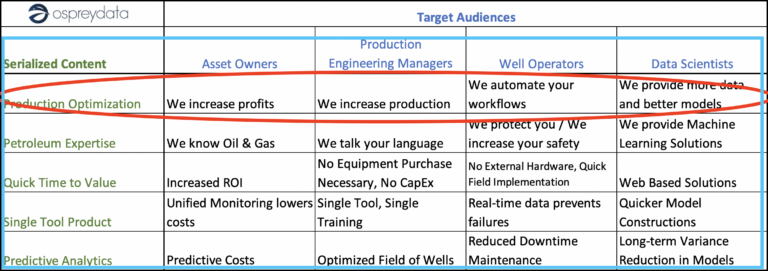
Next, just as it is critical that you identify these repetitive groups of messages that will be communicated across your target audiences, it is also important that all of these messages across the serialized content areas also engage in a level of harmony around your branding. As we discussed previously, it is important to stay on brand. Messages that get “off-brand” will reduce consumer engagement and call-to-action response. Therefore, a level of content harmony must also be planned when creating your content matrix. Content Harmony, signaled by the blue box in the graphic above, is the process by which your narrative reinforces a consistent message across all of your market segments. Often these messages may be organized differently across social media channels based on character limits or presentation style, but the message reinforces the brand story or narrative no matter the channel or platform style. The target audience by serialized content interaction will become a key strategic process for keeping your digital communications effective as we move forward with the other components of our digital inbound strategy, like goal funnel conversions.
We will talk about goal funnel conversions throughout this text, but let’s have an introductory discussion here as we talk about the impact of content serialization and harmony. First, goal conversion processes, depending on the channel of communication (i.e. Blog vs. Facebook vs. Reddit) seeks to increase some measurable action, i.e. likes, followers, sales, etc. Specifically, we will be working with goal funnels located at your website where you will create call-to-action forms on your site and invite users of your site to complete the forms. Your website will save this data once the form has been submitted. We will discuss what to do with this data later in this text, but for now, it is just important to conceptually understand how the goal funnel process works to attract and engage consumers, pulling them into the goal funnel process.
This process uses social media channels to attract consumers to interesting content posted at your website. To do this, you will create a short blurb and hook about the content, and then place a hyperlink in the social post. Through the use of these hyperlinks, consumers are directed back to the blog or web content where there will be a call-to-action request at the end of the content. Your encouragement to complete the form begins the goal funnel tracking process. After the form has been submitted, marketing analytics will be used to help you track the goal conversion process and monitor the audience’s progress through the forms to completion. If the goal funnel process is completed, then you are generated real leads with real data. However, if the form are not being completed, then an auditing of the process will demonstrate where you may need to tweak your form process to drive a higher conversion rate of the desired goal funnel. A consistent monitoring process is always encouraged to confirm that your lead generation process is working correctly.