
Content Marketing is a Consistent Investment
Your goal in starting an inbound marketing campaign is to distribute new and innovative content, created content, that should begin to establish you as a content leader in your domain. This new and innovative content, distributed alongside curated content, or amalgamated content authored previously by the individual, company, or someone else, is the process of content marketing.
Most individuals or businesses today display their content with a blog or microblog site, potentially attached to a corporate website. This task is typically conducted through popular blogsites like WordPress, Blogger, or Tumbler. Additionally, many tools exist that can assist content creators and curators with ideas on topics, formats, and how-to’s. In this sense, content leadership can be presented through many forms, including videos, visual diagrams, tips, innovative research, expert interviews, community news, follower responses, and even comedy, among many other styles of content distribution. But, the key to success in content marketing is consistency. Not every post will resonate with the audience, but a successful curator must stay consistent in four areas: search engine optimization, the editorial calendar, calls-to-action, and social media[1]. The first three are straightforward, but the last one is incredibly challenging; and all four functions in an iterative cycle, constantly building upon each other to a successful crescendo of effects. So let’s discuss these four areas of required consistency.

First, search engine optimization (SEO) is the process of recruiting traffic to a company’s website or blog from free search results on popular search engines like Google, Yahoo, or Bing. High search results come from many strategic keywords that are used on the website, including keywords found in the page title, page description, website or blog copy, blog post headlines, meta tags, hyperlinks to other sights, and hyperlinks back to the company’s site. Algorithms used by these search engines also use reputation to create their list of most useful sites. As for determining the right keywords to use, many tools exist on the Internet to help you identify these keywords, but one of the most popular is Google’s Keyword Research Tool.
Secondly, a curator must be consistent in setting an editorial calendar. Online content has increased dramatically over the last decade, so there are more and more options to choose from for any one individual reader. Hence, the strategy has begun to focus more on original and thoughtful content, rather than number of posts. The rule of thumb seems to be that a blogger should post at least once a week, or maybe once every two weeks, but the content must be valuable. Ideally, one would want to blog as often as possible with the same level of valuable curated content with each additional post, whether that is multiple times a week or less.
Next, every post should have some form of call-to-action. Keep in mind, as the content creator or curator, you spend an ample amount of time creating free information for the reader, which is a valuable service. Therefore, it is completely understandable for you to ask for some type of reciprocation, which comes in the form of a call-to-action. However, these calls need to strictly revolve around the current content being shared. For example, if someone is blogging about a sales technique, then a reasonable call-to-action could be a seminar sign-up for the reader on learning that technique. The goal is to not only attract readers, but to keep them engaged further down the funnel. Remember, the ambition of inbound marketing is lead generation. These leads are generated through call-to-action forms on your site. You will develop your site’s primary goal funnels in Google Analytics, which include your call-to-action forms.
The final key to successful content curation is social media consistency to drive traffic back to a source of content (i.e. blog or website). Keep in mind that search and social are now interconnected. Online searches include many social components into its algorithm, including likes, tweets, +1’s, etc.; therefore, the more content from a blog or website that is socially shared, the higher it will rank in online searches. Additionally, features like #hashtags have made search within the social sphere extremely relevant as well. Again, as previously stated, there is an iterative cycle connected between search and social that connects the four areas of successful content leadership.
As you can see, content marketing is very important within the process of inbound marketing. Therefore, as previously indicated, we will spend numerous chapters on building wise strategies and discussing several tactics in consistently improving your content management in this course. But please understand, social media changes every day at breakneck speeds. There are obvious sites that have become primary tools of communal sociality, like Facebook, Twitter, Instagram, LinkedIn, and Pinterest. However, the astute marketer of these tools realizes that each tool relates differently to their intended audience. Facebook enhances the personal side of life, connecting friends and family with varying degrees of intimacy. Twitter engages the immediacy of the moment, identifying the most current trends and happenings around the world. Instagram, LinkedIn, and Pinterest all cater to their target market in strategic ways as well, different from the other primary tools. This differentiation is what drives success for each of these social media sites, and what engages their audiences.
The key to successful social media marketing is identifying each tools’ strengths and demographic targets, and how to capitalize on each one individually. But this expertise is difficult to achieve, both from a time and content perspective, because today’s digital natives can sense a lack of sincerity in identical posts manifested across multiple platforms. They demand legitimate genuineness on each platform. Otherwise, the marketing message becomes merely another advertisement, lost in cyberspace, failing to connect with the social contingent on an intimate level. Yes, you read that correctly. Each social media channel should use a unique approach with content to maximize their effectiveness, and this takes time to create on a daily/weekly basis. So begin to prepare yourself now… If you aren’t efficient with your time and plan your campaign weeks in advance, it will run away with you. Time management is UBER critical in the land of organic, inbound marketing.
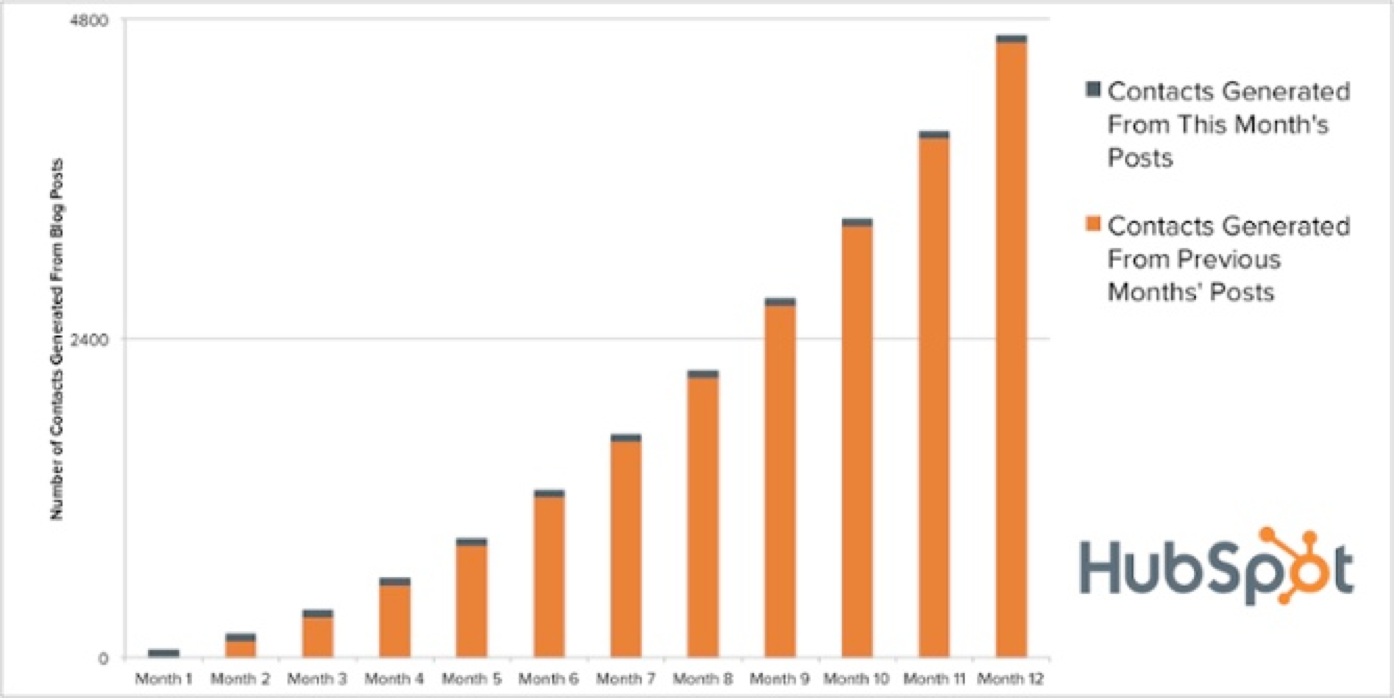
Finally, remember, digital marketing success requires knowing the needs of the target market. In the medium of social media, successful professionals must know the expectations of the audience of each social media platform, and use it correctly. This does not mean that content curators must use every social media tool available, but it does necessitate that they identify the most important for their intended audiences and demonstrate proficiency in their use. Likewise, as with all marketing programs, inbound marketing should be seen as an investment, not an expenditure. Marketing, especially content marketing, is an investment! The consistent proficiency of its use should provide compounding growth on each post, week of posts, and month of posts (see HubSpot research to the right). Once you get started, don’t stop, otherwise your break the compounding nature of your investment efforts. Consistency demonstrates compounding growth, and we promise, if you stay consistently on track with your planned editorial calendar during your practicum, you will see compounding growth, week-over-week.
References:
[1] Hubspot. http://cdn2.hubspot.net/hub/53/file-13193213-pdf/docs/100-inbound-marketing-content-ideas.pdf. Accessed 10/18/22.