
Content Leadership
Segmentation, targeting, and positioning was all about the “who” of Digital Communication Effectiveness (DCE). In the Chapter 3 we discussed the selection of those target audiences by segmenting the larger potential audience into groups to whom your content will readily identify. To build upon this target audience selection, you must now consider “what” those messages should consist of to effectively capitalize on your digital communications. To consider this question of what messages to communicate, we turn to a discussion on content marketing. Content marketing is an approach to create and distribute content to attract and retain an audience. This approach uses informative and useful content on compelling, complex issues to pull consumers into your website where you can generate leads through website call-to-action forms. These forms can request users sign up for a newsletter, subscribe to a blog, follow a social media channel, sell a product or service, among many other functions. As you find your groove in content development and the more that it resonates with the target audience, the more trust, loyalty, and consideration you will gain with them. This leads to you becoming a thought leader in your domain.
Thought leadership is the practice of becoming an expert in the your domain as exemplified by the valuable content that the you create and/or curate. Content creation is when a company or individual creates original content based on their level of expertise and experience, posting this new content into their owned media. Content curation is a process by which a person or team of persons assemble, select, categorize, comment, and present the most relevant, highest quality information to meet the audience’s needs on a specific subject, but is derived from other people’s work not derived from their own level of expertise and experience. Once an individual or company becomes a leader in content creation and curation and the distributed content begins to majorly impact the ideas of potential buyers, then that individual or company becomes a content leader.
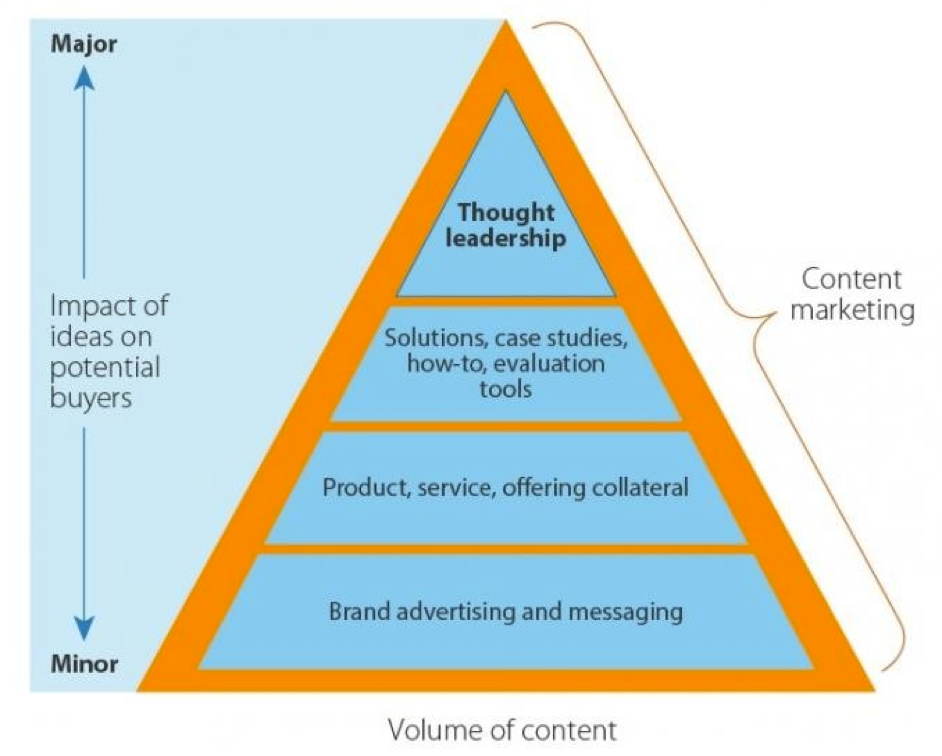 As Heidi Cohen highlights, content leadership is not just the process of aggregating other people’s thoughts on a subject, nor is it completely new or created content that is being presenting, but it is a blend of the two functions; it even encompasses the process by which one gathers information that is currently present in the marketplace and then adds new thoughts of additional value to move the conversation forward[1]. In this manner, as one influences the direction of the dialogue, with time and repeated impact, the curator will become recognized by the target audience and surrounding community as a “content leader”.
In small to large businesses that perform inbound marketing, there are typically four criteria of content leadership:
- Determining who should lead your content marketing,
- Creating or curating content,
- Distributing content, and
- Measuring your content marketing.
Who should lead your content marketing is highly dependent on how many people do you have to perform marketing within your company. Obviously, the more people you have the more defined the roles can be. For example, a company like Coca-Cola has a massive content marketing team with many bloggers, search engine specialists, graphic designers, and sales people. But what happens in smaller companies or in startups? All of these duties are carried out by only a handful of people, and in many cases, all by the same person. Therefore, in these situations, companies or individuals have to be very strategic about how many channels to be invested. In some instances, the company may only have their website hub with a blog, an email delivery system like MailChimp, and one or two social media channels, depending on the demographics of their audience. Trying to add more channels, without compromising other resources, can be very difficult. This is why the message matrix and editorial calendar are so very important. If you have your content planned out weeks or months in advance, the ability to keep your message consistently on brand is undoubtedly easier. Companies that don’t plan their social content are usually all over the place on brand; therefore, their message do not resonate and their impact are poor.
We have just addressed the first criterion of good content leadership here. The other three criteria will be discussed throughout the rest of the text. We will literally spend chapters specifically talking about each one of them after the conclusion of this chapter and level, but before we do, let’s finish our discussion on content management.
References:
[1] Heidi Cohen. How to Curate Content Like a Pro: 8 Lessons. https://contentmarketinginstitute.com/articles/curate-content-pro-lessons/. Accessed 10/18/22.